
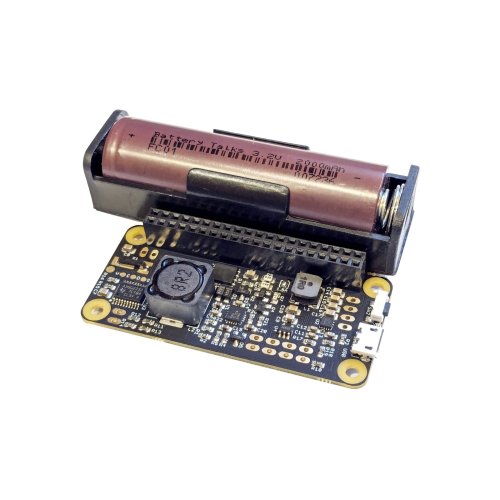
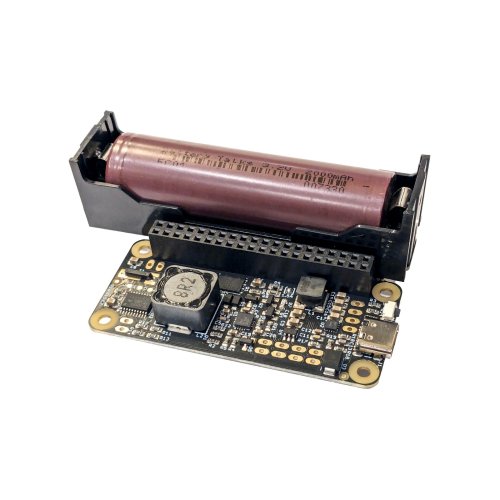
The LiFePO4wered/Pi+™ is a high-performance battery power system for the Raspberry Pi. It can power a Raspberry Pi for up to nine hours from its battery (depending on installed battery size, Raspberry Pi model, attached peripherals, and system load) and can be left plugged in continuously.
Very few people care about power. It’s not glamorous, it’s inconvenient that you need it, and it’s an afterthought in many projects. Yet, nothing works without it. Have you noticed how many project pictures hide the power supply? Most project pictures have a cable running off somewhere; even supposedly autonomous robots often have an umbilical cord run somewhere out-of-frame. People get excited about the processor, the radio, the servos, etc., but never about the power their creation needs. With LiFePO4wered/Pi+, that’s completely fine — you can concentrate on the rest of your awesome project knowing you have a reliable, clean, battery-backed power supply that will keep everything humming along.
Features and Specifications
- High continuous load current whether on battery or external power
- 18650 size 1500 mAh 3.2 V LiFePO4 cell (full specification)
- Maximum 2 A continuous load current
- Smart charge controller
- Over-charge protection: allows the device to stay plugged in continuously and provides UPS functionality.
- Auto-adjusting charge current: charge current up to 1.5 A when used with high-power chargers, but automatically reduces current as needed to not overload low power sources.
- Customizable maximum power point (MPP) voltage: obtain maximum efficiency when powered directly from suitably sized solar panels.
- Smart power manager
- I2C communication: two-way communication with the Raspberry Pi enables easy configuration, monitoring, and clean shutdown.
- Power manager and daemon: work together to ensure clean shutdowns and provide over-discharge protection, resulting in long life and high reliability.
- Continuous monitoring: input voltage, battery voltage, output voltage, and load current are continuously measured and checked against user-programmable thresholds for boot, shutdown, and hard power down.
- On/off button: provides convenient boot/shutdown triggers even in headless setups, with press and hold function to prevent accidental activation (external button can be added).
- Green PWR LED: indicates the Raspberry Pi power state, provides feedback to the user (external power LED can be added).
- Red CHRG LED: indicates power drawn from external input, whether to charge the battery or power the load (external charge LED can be added).
- Wake timer: allows the Raspberry Pi to be off most of the time and wake up as needed for low duty cycle applications.
- Real-time clock: keeps track of time when the Raspberry Pi is off and restores system time on boot, with the ability to wake up at an absolute time.
- Auto boot: can maximize uptime by making the Raspberry Pi run whenever there is sufficient battery power or when external input power is present.
- Auto shutdown: can automatically shut the Raspberry Pi down when input power is removed, either immediately or after a programmable amount of time.
- Application watchdog: can alert a user by flashing the PWR LED or trigger a shutdown/reboot if the user application fails to service the timer within a configurable amount of time.
- Open source host-side tools (see GitHub repo)
- LiFePO4wered daemon: takes care of shutdown and RTC management.
- Command line tool: allows simple configuration and access to all features.
- Shared library, language bindings: C/C++, Python, and Node.js bindings allow integration into user programs.
- Compact physical dimensions
- 52 mm x 75 mm
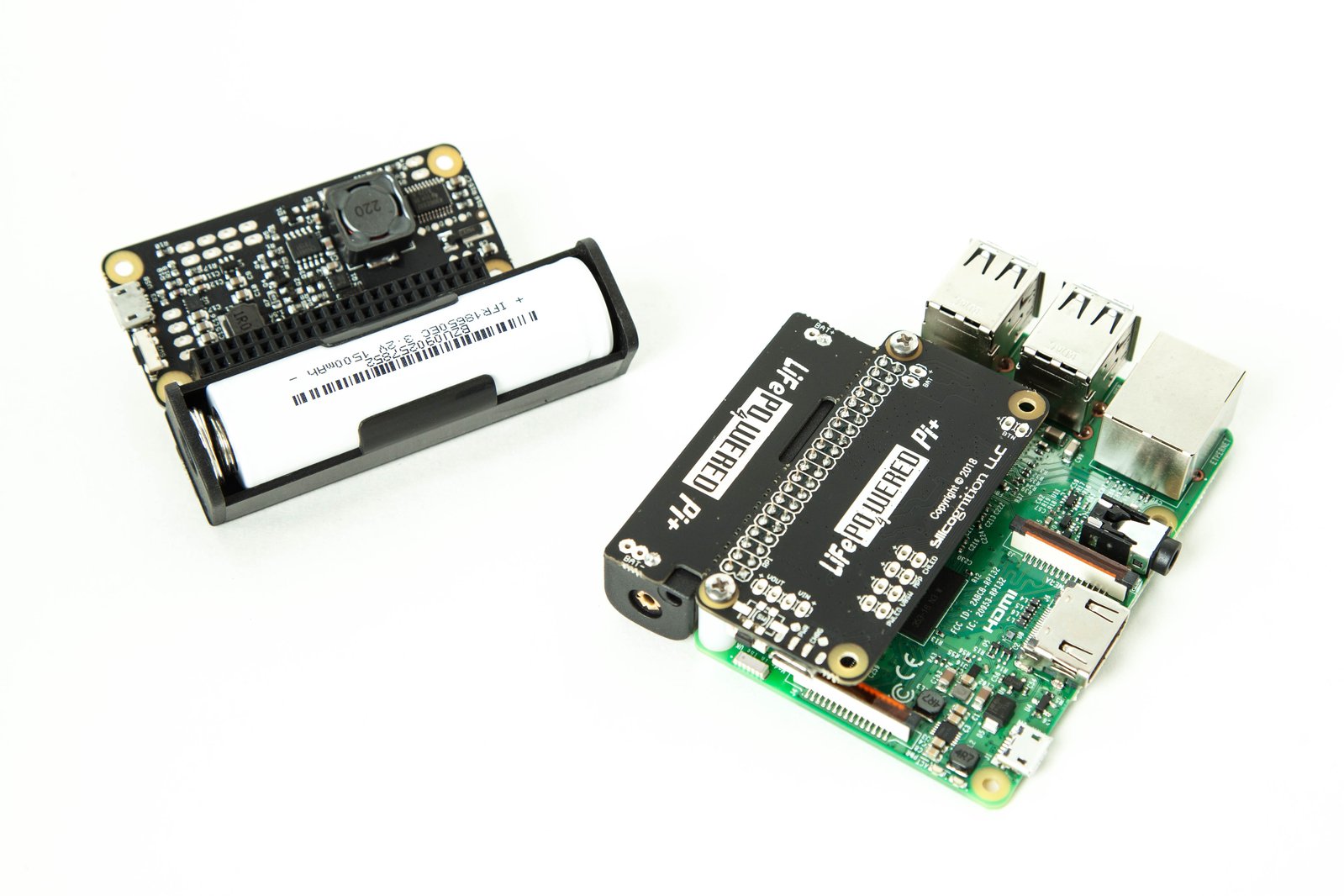
Stackable Header
The LiFePO4wered/Pi+ attaches to the host board using a header and mounting kit (see below). By default, the header is non-stackable, meaning you can’t add other boards once the LiFePO4wered/Pi+ is attached. However, there’s an option for a stackable header which does allow other boards to be attached and powered.
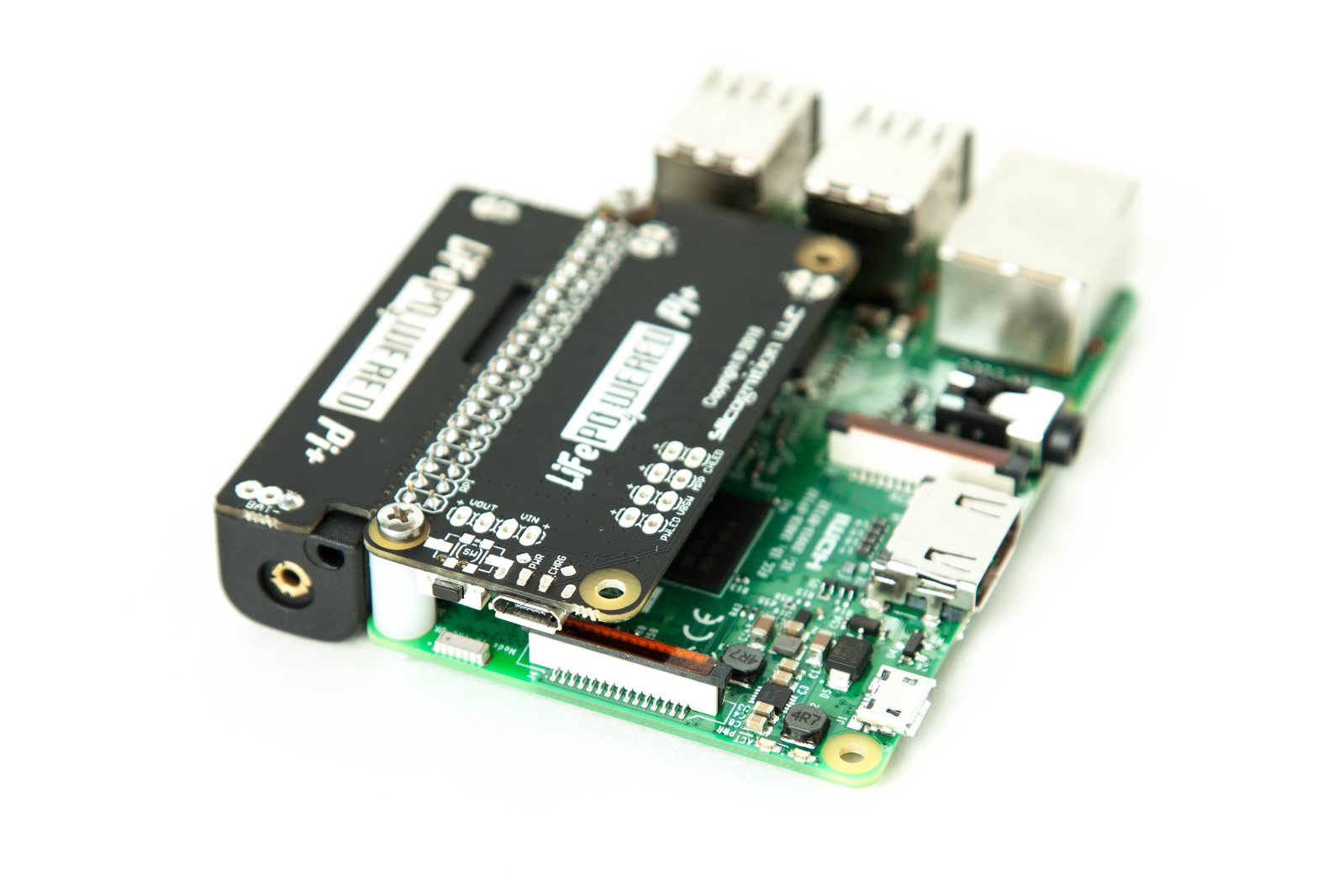
Mounting Kit:
Every LiFePO4wered/Pi+ sold during this campaign will come with a mounting kit to mechanically secure the LiFePO4wered/Pi+ to the Raspberry Pi. The mounting kit consists of two bolts, two nuts, and two spacers.
Compatibility:
The LiFePO4wered/Pi+ with 18650 battery is compatible with all modern, genuine Raspberry Pi products (Model A+, Model B+, 2, 3, 3 Model B+, Zero, and Zero W). LiFePO4wered/Pi+ can be used with the original Raspberry Pi Model A and B boards if you use extra wire or remove the RCA connector from the boards. In addition, we’ve confirmed that LiFePO4wered/Pi+ is compatible with the following non-Raspberry Pi single-board computers: Odroid C2, Nano Pi S2, Allwinner H3, and ASUS Tinker Board. The LiFePO4wered/Pi+ was designed to work with most single-board computers with a Raspberry Pi-compatible GPIO footprint. High-power boards may require modification to heat sinks or using extra headers for spacing.
Expansions and Modifications:
The LiFePO4wered/Pi+ was designed with hackability in mind. There are convenient connection points for easily expanding and modifying its functionality. Some examples:
- Add a case-mounted on/off button.
- Add a case-mounted LED to indicate charging state.
- Add a case-mounted LED to indicate power state.
- Add a resistor to adjust the maximum power point (MPP) for use with solar panels.
- Connect external loads, such as a case fan, to either 5 V or the battery voltage.
- Take out the battery or snap off the whole battery compartment along the perforations and use with bigger LiFePO4 cells.
Comparisons:
The market and technology for embedded computing battery power systems is just now gaining some traction and remains ill-defined, but simple comparisons can still be made in a meaningful way.
For example, the UPS PIco looks like a strong competitor that claims to support 3 A output, but it only comes with a 450 mAh battery, which probably isn’t capable of sustaining 3 A on its own. So, is that 3 A output specification based on component ratings, valid only when it has external power, or is it something else altogether? The LiFePO4wered/Pi+ uses a boost converter rated for 8 A output, but we list it as a 2 A UPS based on real-world testing, which necessarily takes into consideration the thermal properties of the PCB, among other things. Then there’s the fact that the UPS PIco uses LiPo batteries, which are inherently a poor choice for a UPS because they quickly degrade when constantly kept fully charged.
Another example is the Geekworm’s Raspi UPS HAT, which uses a component rated for 3 A and claims to be a 2 A UPS. Yet, when I tested the Raspi UPS HAT, it consistently shut off above 1.5 A and was blazing hot. A third-party analysis confirms this, concluding that "the Geekworm UPS HAT board, as is, is not suitable as the UPS solution for a Raspberry Pi that is used as an unsupervised appliance."
Obviously, I haven’t tested every possible competitor. Instead, I rely on feedback from users, which so far has all been positive and gives me confidence the LiFePO4wered/Pi+ lives up to all its stated specifications in the real world.
Lithium Iron Phosphate: a Primer:
Unlike other battery chemistries, lithium iron phosphate (LiFePO4) batteries are ideally suited for use in an uninterruptable power supply (UPS) because they are:
- Powerful: deliver high continuous load current
- Long-lasting: thousands of recharge cycles, not hundreds
- Safe: don't catch fire or explode
- Stable: 3.2 - 3.3 V during most of discharge
- Durable: low self-discharge rate, no memory effects, no degradation from extended charging
- Environmentally friendly: no heavy metals, RoHS compliant, reusable thousands of times
- Adaptable: operate in cold (down to -20°C) and hot (up to 60°C) environments
If LiFePO4 batteries are so great, why haven’t you heard of them and why aren’t they more widely used? Here are a few reasons:
Reason #1 you’ve never heard of LiFePO4: Ambiguous labeling:
LiFePO4 is one of several kinds of lithium-ion battery, each with quite different properties. LiFePO4 actually are in general use, but you might not know it because they’re often advertised simply as "lithium-ion." For example, LiFePO4 batteries are used a lot in power tools (a reason why 18 V tools are often better than 20 V tools), small vehicles (e.g., golf carts), and as an alternative to lead-acid for automotive 12 V batteries. Solar storage is another up-and-coming application.
Reason #2 you’ve never heard of LiFePO4: Initial capacity is king
For many people, the only important metric for batteries is capacity, and it’s not a metric that makes LiFePO4 look good, at least not at first. For example, a LiFePO4 18650 has a capacity of 1500 mAh. The same size NCA may initially have 3000 mAh capacity. However, the NCA will steadily lose capacity over its life. After a couple hundred cycles, it will have the same capacity as a LiFePO4. After a couple hundred more, it won’t hold charge. In comparison, a LiFePO4 18650 will still have a capacity of ~1200 mAh after 2000 cycles.
Nonetheless, the consumer electronics industry doesn’t care about longevity or reliability, only initial capacity. Listing a high capacity on the spec sheet attracts customers and the sale is long over by the time those customers become disappointed a few hundred charge cycles later. The obsession over initial capacity might be integral to today’s consumer mindset, but there’s also an incentive for manufacturers to keep it that way - it’s an indirect form of planned obsolescence, which leads to more sales.
One result of this mentality is that batteries with high initial capacity are the only ones manufactured in massive volumes. Another result of this is an endless stream of stories about hoverboards that catch fire, Samsung’s exploding batteries, Apple’s "batterygate" (in my opinion, from a technical perspective, Apple actually did the right thing by reducing peak load on old cells), and UPS PIco users complaining that their UPS doesn’t hold charge anymore (see review by John Bishop posted 2017-01-19).
In contrast, the LiFePO4wered/Pi+ focuses on the embedded market, where things need to last. By using LiFePO4, I trade initial capacity for safety, reliability, and longevity. People buy what’s easy to get and right now everyone stocks cheap LiCo and LiPo batteries. For LiFePO4, you usually need to import from China. I’m trying to change that.
Support and Documentation
- Datasheet
- 18650 battery specification
- Circuit schematic
- Host-side software tools and libraries
- Third-party 3D-printed enclosure design
- Third-party acrylic enclosure kit
- Hackaday.io
- Website: http://lifepo4wered.com/
Package Includes:
- 1 x LiFePO4wered/Pi+
LiFePO4wered/Pi+
- Brand:: Crowd Supply
- Product Code: :CS-LiFePO4wered/Pi+
- Reward Points: :91
- Availability: :In Stock
-
रo 9,319.00
- Price in reward points: 9319
-
- 2 or more रo 8,072.00
- 5 or more रo 7,426.00
- 10 or more रo 7,046.00
- 20 or more रo 6,854.00
Available Options
Related Products
-200x200.png "LiitoKala Lii-M4 Smart Battery Charger LCD display test the battery capacity for 18650 26650 21700 18350 14500 AA AAA batteries")
LiitoKala Lii-M4 Smart Battery Charger LCD display test the battery capacity for 18650 26650 21700 18350 14500 AA AAA batteries
LiitoKala Lii-M4 battery chargerSpecifications:Type: Standard battery chargerPort: 1 x USB, TYPE-CFu..
रo 2,795.56
Tags: LiFePO4wered/Pi+